
AML/CFT Compliance & KYC Essentials
A practical AML/CFT and KYC workshop that helps financial institutions and regulated organisations strengthen customer due diligence, identify red flags, improve reporting and prepare for supervisory scrutiny.
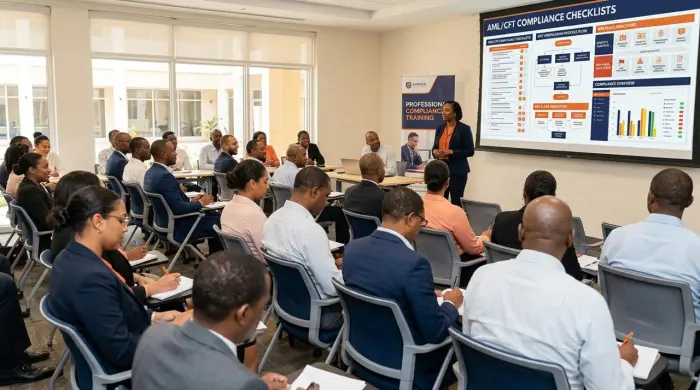
What this workshop addresses
As Jamaica tightens its regulatory framework against money laundering and terrorist financing, organisations of every size face escalating obligations — and escalating consequences for getting it wrong. AML/CFT Compliance & KYC Essentials is a high-impact workshop from Blakes' Training Institute that demystifies the Proceeds of Crime Act (POCA), the Financial Services Commission Act, Bank of Jamaica AML/CFT directives, and the obligations placed on non-profit organisations under the NPO Act. Participants move from theory to practice: identifying red flags, conducting and documenting Know-Your-Customer due diligence, understanding beneficial ownership, and building a compliance culture that protects their institution's licence, reputation and community standing. Whether you are strengthening an existing programme or building one from the ground up, this workshop equips your team to meet supervisor and regulator expectations with confidence.
Recommended participants
- Compliance officers, MLROs and risk managers in banks, credit unions, microfinance institutions, cambios and remittance service providers; directors and senior executives with statutory AML/CFT oversight responsibility; frontline onboarding, customer service, teller and relationship-management staff who perform KYC; NPO board members, officers and administrators managing funds under NPO Act obligations; accountants, attorneys, real estate agents, jewelers and other designated non-financial businesses and professions with reporting and record-keeping duties; internal auditors and operations managers responsible for monitoring, escalation and controls.
Key objectives
- By the end of the workshop, participants will be able to:
- Understand the legal landscape — the requirements of POCA, the FSLAA, BOJ AML/CFT directives, FSC rules and the NPO Act, and how they apply to the organisation.
- Conduct effective KYC/CDD — perform customer identification, verification, beneficial ownership checks, and risk-based enhanced due diligence.
- Recognise red flags — spot the typologies and suspicious patterns of money laundering and terrorist financing relevant to the sector.
- Fulfil reporting obligations — know when and how to file Suspicious Transaction Reports and maintain compliant records and retention schedules.
- Strengthen internal controls — design proportionate AML/CFT policies, sanction-screening procedures, escalation paths and staff training programmes.
- Build a culture of compliance — embed accountability from the boardroom to the frontline and prepare the organisation for supervisory examinations.
Key measurable KPIs after training
- 100% of participants pass the post-workshop competency assessment (target score: 80%+)
- Measurable reduction in KYC documentation errors and incomplete customer files within 90 days
- Improved STR quality — fewer rejected or returned suspicious transaction reports due to insufficient detail
- Faster onboarding times with risk-based, risk-proportionate due diligence
- Policy currency — updated, board-approved AML/CFT policies and procedures within 60 days of training
- Audit readiness — satisfactory results in internal compliance reviews and external supervisory examinations
- Sustained knowledge retention — demonstrated through quarterly refresher scores and refresher-case performance
How best to use this training
Run the programme organisation-wide but tier content by role: full workshop for compliance and management teams and focused frontline modules for customer-facing staff. Schedule it before supervisory examinations, licence renewals, or new product/payment-channel launches. Use workshop cases and red-flag exercises in internal audit and monitoring. Reinforce learning at 30, 60 and 90 days with refresher quizzes, updated cases and supervisor check-ins, and repeat annually as regulatory requirements evolve. Maintain attendance, assessments and certificates as evidence of staff training. Tailor scenarios and checklists to the institution's specific sector and obligations.
Key topics
- Jamaica AML/CFT legal and supervisory framework
- POCA
- KYC and customer due diligence
- Customer identification and verification
- Beneficial ownership
- Risk-based due diligence
- Enhanced due diligence
- AML/CFT red flags and typologies
- Suspicious Transaction Reports
- Record keeping and retention
- Sanctions screening
- Escalation procedures
- Internal controls
- Board and management accountability
- Supervisory examination readiness