
Fraud Prevention & Cybersecurity Awareness
Equip staff to recognise, resist and report social engineering, phishing, insider fraud and mobile/digital fraud before those threats become financial or reputational losses.
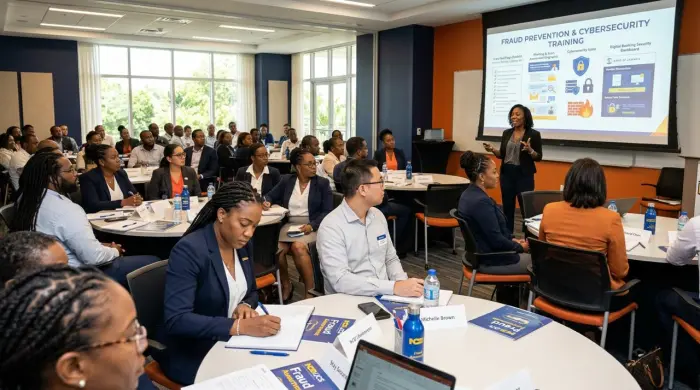
What this workshop addresses
Fraud has gone digital, and so have the fraudsters. From sophisticated phishing emails and voice-cloning scams to insider schemes and mobile payment fraud, today's threats target every level of an organisation — often bypassing technology entirely by exploiting human trust. Fraud Prevention & Cybersecurity Awareness is a high-impact workshop from Blakes' Training Institute that equips staff to recognise, resist and report fraud attempts before they cause harm. Participants learn how social engineering works, how to spot phishing and business email compromise, how insider fraud takes root, and what controls protect mobile and digital transactions. Through real-world Jamaican and regional case studies, hands-on red-flag exercises, and practical defence checklists, your team leaves with the awareness and habits that turn your people from the weakest link into the strongest line of defence.
Recommended participants
- Frontline customer service, teller, call-centre and onboarding teams; finance, treasury and payments staff; managers and supervisors responsible for approvals and sensitive processes; IT staff and system administrators; HR professionals involved in onboarding, offboarding and insider-risk awareness; board members and executives; and small business owners and administrators who manage digital banking, mobile money and online platforms without dedicated IT security teams.
Key objectives
- By the end of the workshop, participants will be able to:
- Understand the fraud landscape — major fraud typologies affecting Jamaican and regional organisations, including emerging mobile and digital risks.
- Recognise social engineering and phishing — identify pretexting, impersonation, spear-phishing, business email compromise and voice-cloning scams.
- Detect insider fraud — understand occupational fraud, collusion, asset misappropriation and related red flags.
- Secure digital and mobile transactions — apply safe practices for online banking, mobile money, passwords, MFA and device hygiene.
- Respond and report effectively — follow escalation processes, preserve evidence and meet internal, regulatory and law-enforcement reporting expectations.
- Build a fraud-aware culture — embed prevention habits, whistle-blowing channels and continuous awareness into everyday operations.
Key measurable KPIs after training
- 90%+ of participants pass the post-workshop fraud-awareness assessment (target score: 80%+)
- Reduction in phishing click rates on simulated phishing tests within 90 days, with a suggested target below 5%
- Increase in reported suspicious incidents as staff identify and escalate threats earlier
- Measurable drop in fraud losses, chargebacks and unauthorised transactions quarter over quarter
- Faster incident response times from detection to escalation
- Improved audit findings on access controls, segregation of duties and payment approvals
- Sustained vigilance through quarterly refresher quizzes and simulated scam exercises
How best to use this training
Deploy the core workshop organisation-wide, with deeper insider-fraud and control modules for finance, IT and management. Include it in new-hire induction. Pair training with simulated phishing and social-engineering exercises within 30 days and repeat quarterly. Schedule ahead of peak-risk periods or after near misses/incidents. Reinforce learning with short monthly scam alerts, refresher quizzes and supervisor check-ins. Retain training, assessment and simulation records as evidence of due diligence, and customise scenarios to the organisation's sector and actual fraud exposure.
Key topics
- Fraud typologies
- Social engineering
- Phishing and spear phishing
- Business email compromise
- Impersonation and pretexting
- Voice-cloning scams
- Insider fraud
- Collusion and asset misappropriation
- Mobile and digital payment fraud
- Online banking safety
- Passwords and MFA
- Device hygiene
- Fraud escalation
- Evidence preservation
- Whistle-blowing
- Segregation of duties
- Payment approvals
- Fraud-aware culture