
Board Governance & Regulatory Readiness for Credit Union Directors
Prepare credit union directors and committee members to strengthen governance, prudential oversight, compliance and examination readiness.
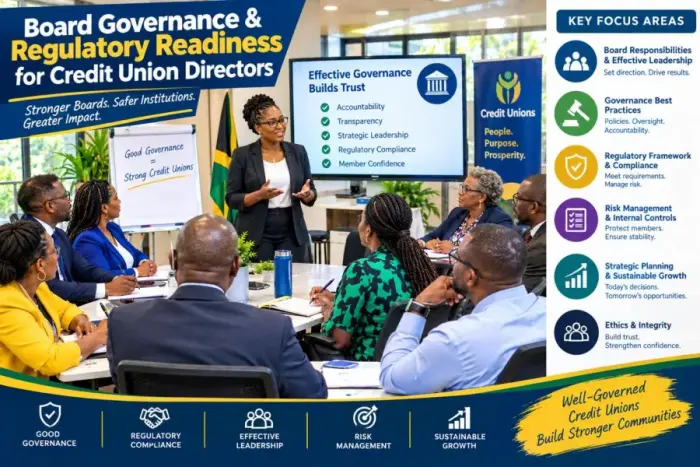
What this workshop addresses
Jamaica's credit unions operate within a Bank of Jamaica supervisory environment that places significant emphasis on prudential governance, reporting and director accountability. Board Governance & Regulatory Readiness for Credit Union Directors is a targeted workshop from Blakes' Training Institute that helps new and experienced directors understand their fiduciary responsibilities, board and committee oversight, prudential performance, compliance expectations and the evidence regulators and examiners expect to see. Through scenario exercises and structured self-assessment, boards strengthen their ability to govern with confidence, discipline and a clear tone from the top.
Recommended participants
- Directors of credit unions, including new and experienced board members; board chairpersons and vice-chairpersons; credit, supervisory, audit and risk committee members; general managers, CEOs and company secretaries who support the board; supervisory and internal audit leads who report to the board; and candidates preparing for election or appointment to credit union governance.
Key objectives
- By the end of the workshop, participants will be able to:
- Understand the supervisory landscape — the BOJ framework applicable to credit unions, prudential supervisory expectations, and how supervision, examination and enforcement operate.
- Master fiduciary and legal duties — duties of care, loyalty and diligence, conflict-of-interest management and director accountability.
- Strengthen board structures and oversight — board composition, committee mandates, delegation of authority, and effective oversight of management and strategy.
- Direct risk and prudential performance — read and challenge capital, liquidity, credit concentration, provisioning and related risk reports.
- Champion compliance and AML/CFT at board level — understand the board's oversight role and establish a strong tone from the top.
- Build regulatory readiness — prepare for examinations and reviews, respond to findings, maintain required documentation and embed continuous board evaluation and training.
Key measurable KPIs after training
- 90%+ of directors pass the post-workshop governance and prudential competency assessment (target score: 80%+)
- Board self-assessment completed and action plan adopted within 60 days, with gaps assigned to owners and timelines
- Improved examination readiness — fewer repeat or critical findings in subsequent supervisory reviews and internal audits
- Governance documentation currency — board charter, committee terms of reference, conflict-of-interest registers and minutes meeting expected standards
- Stronger board reporting — complete, timely prudential and compliance reports reaching the board at scheduled meetings
- Director attendance and engagement — documented board attendance and refresher training
- Sustained knowledge through annual refresher assessments and onboarding of new directors within 90 days of appointment
How best to use this training
Train the full board and key committees together so governance expectations are understood as a collective responsibility. Schedule the programme before an AGM, new board term, supervisory review or major strategic decision. Use the workshop self-assessment to build a board development action plan and review progress quarterly. Align the governance work with updates to the compliance calendar, AML/CFT programme, risk appetite statement and board reporting pack. Include the programme in new-director induction and retain attendance, assessments and action plans as evidence of governance diligence and continuing director development.
Key topics
- Credit union governance
- Director fiduciary duties
- Board accountability
- Conflict-of-interest management
- Board composition
- Committee mandates
- Delegation of authority
- Management oversight
- Strategic oversight
- Capital adequacy
- Liquidity
- Credit concentration
- Provisioning
- Risk appetite
- AML/CFT board oversight
- Compliance culture
- Regulatory examination readiness
- Board documentation
- Board self-assessment
- Director induction and continuing education