
Supervisory & Frontline Leadership in Financial Services
Develop supervisors who can coach tellers, loan officers and member-services staff, manage daily performance, handle escalations and build consistent, compliant frontline teams.
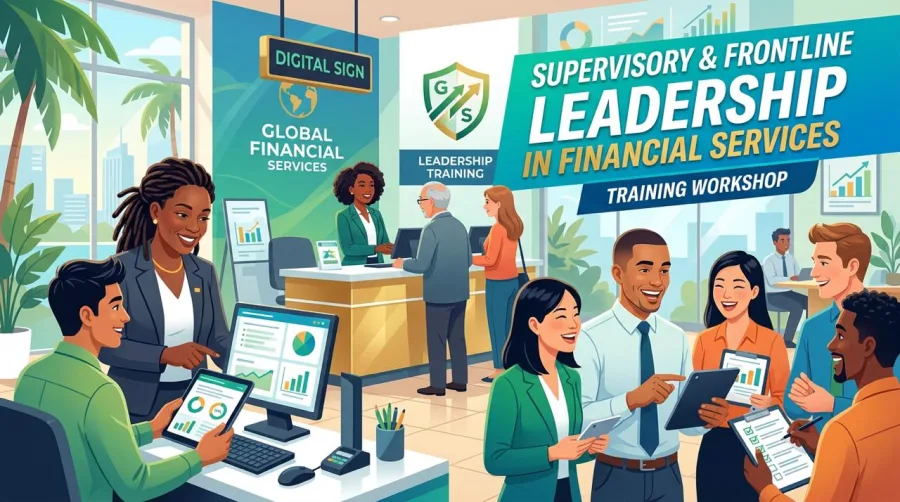
What this workshop addresses
In financial services, the member experience is made or broken at the frontline — and frontline performance is made or broken by the supervisor. Yet many supervisors are promoted for technical excellence without ever being equipped to lead: to coach a teller through a difficult transaction, develop a loan officer's judgment, or lift the energy of a member services team through a demanding day. Supervisory & Frontline Leadership in Financial Services is a practical, high-impact workshop from Blakes' Training Institute that builds those skills deliberately. Participants learn to coach with confidence, give feedback that changes behaviour, run effective huddles and one-on-ones, manage daily performance against service and sales targets, handle difficult conversations and escalations, and model the professionalism and compliance mindset their teams must follow. Through role-plays, coaching practice and action plans built on real workplace situations, supervisors leave ready to turn their teams into consistent, compliant, high-performing units.
Recommended participants
- Newly promoted supervisors and team leads; experienced frontline supervisors; branch and department managers; operations and member-experience managers; HR and training officers; and high-potential frontline staff being prepared for supervisory promotion.
Key objectives
- By the end of the workshop, participants will be able to:
- Master the supervisor's role — understand the shift from doing to leading and accountability for performance, service and compliance.
- Coach for performance — apply practical coaching models, observe frontline transactions and develop staff through structured on-the-job coaching.
- Give feedback that works — deliver timely, specific and constructive feedback, recognise strong performance and navigate difficult conversations.
- Manage daily performance — run effective huddles, set and track service and sales targets, monitor queues and workflows, and address underperformance early and fairly.
- Handle escalations and difficult members — lead through complaints, errors and service-recovery situations while protecting staff morale and reputation.
- Lead compliance and professionalism at the frontline — model controls, KYC discipline and ethical standards and build a culture in which concerns are raised early.
Key measurable KPIs after training
- 90%+ of participants pass the post-workshop leadership assessment (target score: 80%+)
- Each supervisor establishes a documented one-on-one and coaching cadence with direct reports within 30 days
- Improved frontline service metrics including transaction and complaint-resolution times and member satisfaction within one quarter
- Reduced escalations and errors requiring correction or management intervention
- Improved staff retention and engagement, including better internal survey results on supervision quality
- Stronger internal promotion pipeline with more frontline staff progressing to senior and supervisory roles
- Sustained application through quarterly leadership refreshers and supervisor action-plan reviews
How best to use this training
Train supervisors and their managers together so expectations are consistent across branches and departments. Schedule the workshop at promotion points and include it in succession-development plans. Each supervisor should leave with a 30-60-90 day coaching action plan reviewed by their manager at monthly check-ins. Align coaching exercises with current member satisfaction, error, service and audit findings. Reinforce the training through quarterly refreshers, peer-coaching circles and manager walk-throughs, and retain attendance, assessments and action plans as evidence of supervisory development.
Key topics
- Transition from technical expert to supervisor
- Supervisor accountability
- Coaching models
- On-the-job coaching
- Observation and debriefing
- Constructive feedback
- Recognition
- Difficult conversations
- Daily huddles
- One-on-one meetings
- Service targets
- Sales targets
- Queue and workflow management
- Underperformance
- Complaint escalation
- Service recovery
- Staff morale
- Frontline compliance
- KYC discipline
- Professional conduct
- Team culture
- Succession development