
Ethics, Confidentiality & Professional Conduct in Finance
Equip financial-services professionals to protect trust, apply Jamaica's Data Protection Act, manage conflicts of interest, safeguard confidential information and respond appropriately to misconduct.
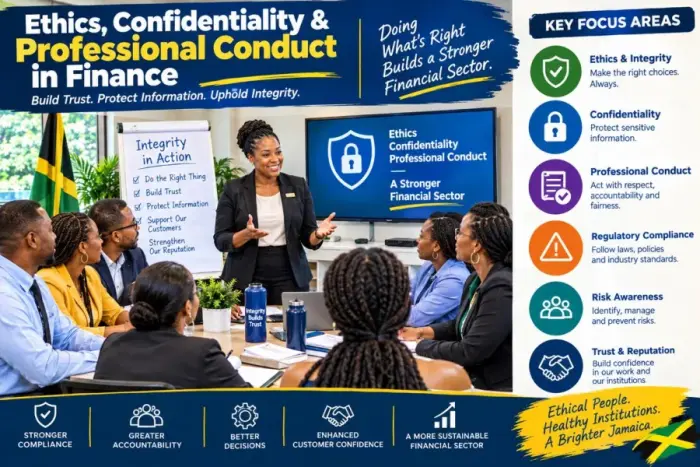
What this workshop addresses
In today's financial services environment, trust is the most valuable asset an institution holds — and it takes years to build and only minutes to lose. This workshop equips finance professionals with the practical knowledge and ethical judgment needed to protect that trust. Participants will examine real-world dilemmas in confidentiality, data privacy and professional conduct, with a focused study of Jamaica's Data Protection Act (2020) and its obligations for handling client and employee personal data, as well as proven frameworks for identifying, disclosing and managing conflicts of interest. Through scenario-based exercises aligned with Jamaican regulatory expectations and international best practice, participants leave able to act with integrity, protect sensitive information, and represent their institution with credibility.
Recommended participants
- Finance officers, accountants and accounting supervisors; compliance, risk and internal audit professionals; client-facing and customer service staff in banking, insurance, credit unions and investment firms; human resource and records/administration officers handling employee and client data; team leaders, managers and department heads; and board members and senior executives seeking governance-level awareness.
Key objectives
- By the end of the workshop, participants will be able to:
- Understand the ethical foundations of financial services — integrity, objectivity, professional competence, confidentiality and professional behaviour — and apply them to daily decision-making.
- Apply Jamaica's Data Protection Act (2020) — understand data subject rights, lawful processing, consent, the role of the Information Commissioner, breach-notification duties and the consequences of non-compliance.
- Strengthen confidentiality practices — securely handle client records, apply information-classification principles, practise clean-desk and digital hygiene, and disclose information responsibly.
- Identify and manage conflicts of interest — recognise conflicts, apply disclosure protocols and recusal, manage gift and hospitality boundaries, and protect objectivity in procurement, lending and client relationships.
- Recognise and respond to misconduct — identify fraud red flags, use whistleblowing channels appropriately, understand retaliation protections and fulfil duties to report under professional codes and internal policy.
- Build a culture of professional conduct — align personal ethics with institutional codes of conduct, use escalation pathways correctly, and understand the reputational and legal cost of ethical lapses.
Key measurable KPIs after training
- Knowledge gain — ≥80% average score on pre/post ethics and Data Protection Act assessment
- Application — 100% of participants complete a workplace ethics/data-handling action plan within 2 weeks
- Policy awareness — ≥90% of staff correctly identify reporting channels and data subject rights in spot-checks
- Incident response — reduced time to report suspected data breaches or conflicts, with same-day reporting as the target
- Compliance behaviour — increased logging of gifts, hospitality and conflicts of interest, indicating a healthier disclosure culture
- Data handling audit — improved internal audit scores for file handling, access controls and records management within one quarter
- Retention and confidence — ≥90% of participants rate themselves confident in applying Data Protection Act principles at the 30-day follow-up
How best to use this training
Use the workshop as the launch point for an ongoing ethics programme rather than a one-off event. Immediately after the session, each participant's supervisor should review and endorse the participant's personal action plan, followed by a 30-day check-in to reinforce Data Protection Act and conflict-of-interest concepts. Embed the content into onboarding for new finance hires and refresh annually, particularly when regulatory guidance changes. Use pre/post assessments and workplace KPIs as evidence for regulators, auditors and boards, and reinforce the training through an updated code of conduct, visible whistleblowing channels, leadership modelling and anonymised case-study bulletins based on real workplace near-misses.
Key topics
- Ethical foundations in financial services
- Integrity and objectivity
- Professional competence
- Confidentiality
- Professional behaviour
- Jamaica Data Protection Act 2020
- Data subject rights
- Lawful processing
- Consent
- Information Commissioner
- Data breach response
- Client and employee data
- Information classification
- Clean-desk practices
- Digital hygiene
- Conflicts of interest
- Disclosure and recusal
- Gifts and hospitality
- Procurement ethics
- Lending ethics
- Fraud red flags
- Whistleblowing
- Retaliation protections
- Duty to report
- Codes of conduct
- Escalation pathways
- Ethical culture