
Cash Handling, Reconciliation & Operational Controls
Strengthen cash handling, daily balancing, reconciliation, exception management and internal-control discipline so teams remain accurate and audit-ready.
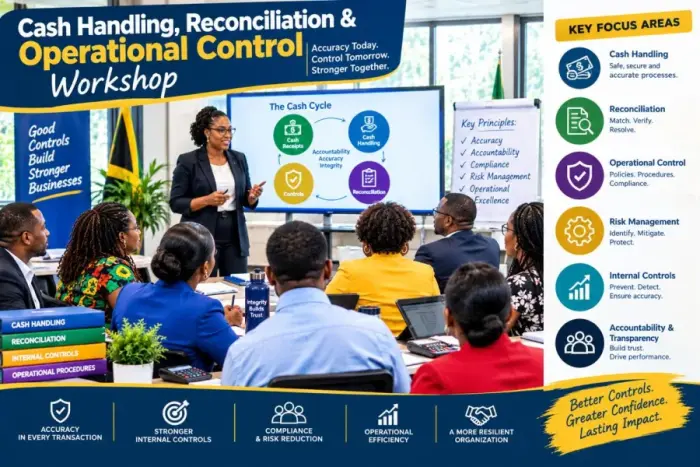
What this workshop addresses
Cash is the lifeblood of any financial institution — and the area where small errors and weak controls cost the most. A mismatched teller drawer, an unreconciled suspense account, or a missing dual-control step can quietly grow into significant losses, audit findings and reputational damage. Cash Handling, Reconciliation & Operational Controls is a practical, high-impact workshop from Blakes' Training Institute that strengthens the disciplines behind back-office accuracy. Participants master best-practice cash counting, balancing and vault procedures, learn to reconcile accounts and suspense items methodically, understand the internal controls — segregation of duties, dual authorisation, daily limits and exception reporting — that prevent and detect loss, and prepare the documentation that keeps them audit-ready every day, not just at examination time. Through hands-on reconciliation exercises, control-gap diagnostics and real-world case studies, your team leaves with the accuracy, discipline and control mindset that examiners and auditors trust.
Recommended participants
- Tellers and cashiers; vault and ATM custodians; back-office and operations staff; branch operations managers and supervisors; internal audit and compliance staff; and managers of small financial institutions including credit unions, MFIs, SACCOs and remittance operators.
Key objectives
- By the end of the workshop, participants will be able to:
- Handle cash with precision — apply best-practice counting, verification, vault, ATM and transit procedures.
- Reconcile methodically — perform teller balancing, account and suspense reconciliations, investigate differences promptly and document resolutions.
- Understand and apply internal controls — segregation of duties, dual authorisation, transaction and vault limits, override monitoring and surprise counts.
- Detect and escalate exceptions — recognise red flags of error, shortage, kiting and internal fraud and follow the correct escalation path.
- Achieve audit readiness — maintain complete records, checklists and sign-offs so daily files can withstand audit or examination.
- Strengthen the control culture — take ownership of accuracy and compliance and contribute to a workplace where exceptions are surfaced, not hidden.
Key measurable KPIs after training
- 90%+ of participants pass the post-workshop controls assessment (target score: 80%+)
- Measurable reduction in daily balancing differences and faster same-day resolution within 30 days
- Improved reconciliation timeliness, with suspense and control accounts cleared within prescribed timeframes and ageing items reduced
- Reduced audit and examination findings on cash and operational controls at the next review cycle
- Fewer control overrides and policy exceptions, with remaining exceptions properly documented and approved
- Faster detection and same-day escalation of errors and discrepancies
- Sustained discipline through unannounced cash counts, spot audits and quarterly refresher assessments
How best to use this training
Train the full cash-handling chain together — tellers, vault custodians, back-office staff and supervisors — so controls and hand-offs are understood end-to-end. Schedule the workshop before audit/examination windows or year-end processes. Apply the reconciliation exercises and checklists immediately to the institution's own processes and track balancing and suspense metrics against the pre-training baseline. Use the control modules to refresh cash-handling procedures, limits and override rules within 60 days, reinforce standards with surprise counts and spot checks, and maintain training records and staff sign-offs as evidence of control diligence.
Key topics
- Cash counting and verification
- Teller balancing
- Vault controls
- ATM controls
- Cash in transit
- Account reconciliation
- Suspense-account reconciliation
- Clearing and settlement
- Difference investigation
- Segregation of duties
- Dual authorisation
- Transaction limits
- Vault limits
- Override monitoring
- Surprise counts
- Exception reporting
- Kiting
- Internal fraud red flags
- Operational escalation
- Audit documentation
- Control checklists
- Staff sign-offs
- Audit readiness