
Succession Planning for Manufacturing: Building Tomorrow's Leaders Today
A practical succession-planning workshop that helps manufacturers identify critical positions, assess future leaders and specialists, transfer technical knowledge and build sustainable leadership and technical talent pipelines.
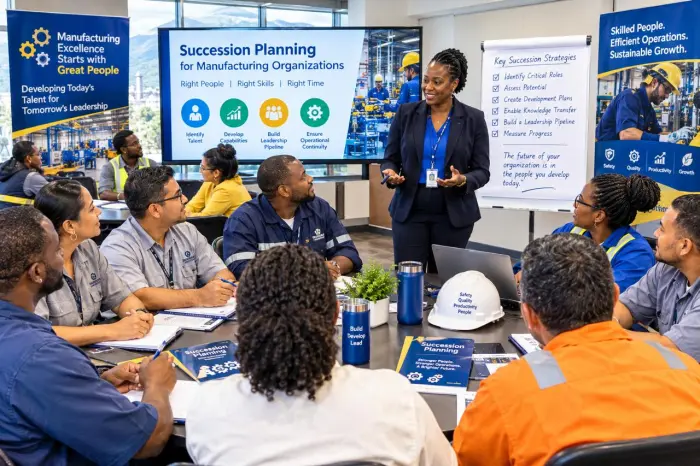
What this programme addresses
Manufacturing organizations rely on experienced leaders, technical specialists, production supervisors, engineers and skilled operators whose knowledge directly affects productivity, quality, safety, equipment reliability and operational continuity. This workshop helps manufacturers identify critical roles, develop internal talent, transfer technical knowledge and establish a sustainable pipeline of future leaders and specialists.
Workshop objectives
- Identify Critical Manufacturing Positions
- Help organizations identify roles that are essential to production, quality, safety, maintenance, supply chain, technical operations and business continuity.
- Identify and Assess Potential Successors
- Equip managers to assess employees based on performance, technical competence, leadership potential, problem-solving ability, experience and readiness for future responsibilities.
- Develop Individual Successor Development Plans
- Help organizations create practical development plans involving mentoring, coaching, job rotation, cross-training, acting assignments, special projects and technical training.
- Strengthen Technical and Institutional Knowledge Transfer
- Enable organizations to capture and transfer critical knowledge before experienced employees retire, resign or move into other positions.
- Build a Leadership and Technical Talent Pipeline
- Develop structured career pathways such as Operator → Team Leader → Supervisor → Production Manager → Plant Manager and Technician → Senior Technician → Maintenance Supervisor → Maintenance Manager.
- Establish a Sustainable Succession System
- Enable management and HR to integrate succession planning with workforce planning, performance management, talent reviews, competency development and strategic business planning.
Recommended participants
- Senior and Executive Leadership:
- CEOs / Managing Directors
- General Managers
- Plant Managers
- Operations Managers
- Production Managers
- Factory / Manufacturing Managers
- Department Heads
- Engineering Managers
- Supply Chain Managers
- Production and Operations Leadership:
- Production Supervisors
- Shift Supervisors
- Production Team Leaders
- Operations Supervisors
- Maintenance Managers / Supervisors
- Warehouse Managers / Supervisors
- Inventory Managers
- Logistics Managers
- Facilities Managers
- HSE / Safety Managers
- Technical and Specialist Functions:
- Quality Assurance / Quality Control Managers
- Industrial Engineers
- Process Engineers
- Maintenance Engineers
- Automation / Technical Specialists
- Lean / Six Sigma Professionals
- Continuous Improvement Officers
- Supply Chain Professionals
- Procurement Managers
- Production / Business Analysts
- Research and Development Personnel
- Technical Trainers
- Potential Successors:
- High-performing employees
- High-potential employees
- Supervisors and team leaders
- Assistant managers
- Experienced operators
- Skilled technicians
- Engineers preparing for leadership
- Emerging managers
- Employees with critical technical knowledge
- Employees preparing for specialist or management positions
Best suited for
Manufacturing companies seeking to reduce key-person risk, strengthen leadership continuity, preserve technical and institutional knowledge, improve internal mobility and deliberately develop future plant, production, maintenance, quality and specialist leaders.
How the learning can be applied
This workshop is best applied as an ongoing workforce and business-continuity process rather than only when a vacancy arises. Manufacturers should begin by identifying roles where the loss of an experienced employee could significantly affect production, quality, safety, maintenance, supply-chain performance or equipment reliability.
Examples of development pathways include:
Production Operator → Team Leader → Production Supervisor → Production Manager
Technician → Senior Technician → Maintenance Supervisor → Maintenance Manager
Quality Inspector → Quality Supervisor → QA / QC Manager
Organizations should then assess successor readiness, identify competency and experience gaps, establish development plans and strengthen mechanisms for technical and institutional knowledge transfer.
Key topics
- Understanding succession planning in manufacturing
- Critical-role and key-person risk mapping
- Production, quality, maintenance and safety continuity
- Identifying high-potential and high-performing employees
- Technical competence versus leadership potential
- Successor-readiness assessment
- Competency-gap analysis
- Individual development planning
- Mentoring and coaching
- Job rotation and cross-training
- Acting assignments and stretch projects
- Technical and institutional knowledge transfer
- Capturing tacit knowledge from experienced operators and specialists
- Production and maintenance career pathways
- Leadership pipeline development
- Specialist and technical talent pipelines
- Talent-review discussions
- Integrating succession with workforce planning
- Integrating succession with performance management
- Competency development
- Monitoring successor readiness and critical-role coverage