
Succession Planning for Ports & Logistics: Building Tomorrow's Operational Leaders Today
A practical succession-planning workshop that helps ports and logistics organizations identify critical roles, assess future leaders, transfer operational knowledge and build sustainable leadership and technical talent pipelines.
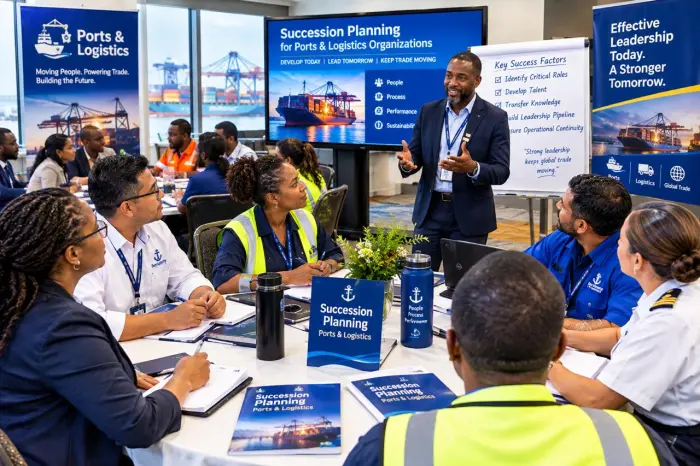
What this programme addresses
Ports and logistics organizations depend on specialized knowledge, experienced operational leaders, technical expertise, safety awareness, regulatory knowledge and strong coordination across multiple stakeholders. A sudden loss of experienced personnel can affect vessel operations, cargo movement, customs processes, equipment utilization, safety and customer service. This workshop helps organizations identify critical roles, develop internal talent, transfer operational knowledge and establish a sustainable leadership pipeline.
Workshop objectives
- Identify Critical Operational and Leadership Roles
- Enable organizations to identify positions that are essential to port operations, cargo movement, logistics, safety, compliance, customer service and business continuity.
- Identify and Assess Potential Successors
- Equip managers with practical methods for assessing employees based on performance, technical competence, leadership potential, operational experience and readiness for greater responsibility.
- Develop Individual Successor Development Plans
- Enable organizations to create practical development plans using coaching, mentoring, job rotation, cross-training, acting assignments, special projects and targeted training.
- Strengthen Knowledge Transfer
- Help organizations capture and transfer critical knowledge relating to port procedures, cargo handling, customs processes, equipment, safety, stakeholder relationships and operational systems.
- Build a Leadership and Technical Talent Pipeline
- Create structured development pathways such as Operations Employee → Team Leader → Supervisor → Assistant Manager → Manager → Senior Operations Leader, with comparable pathways for technical, logistics, customs, supply-chain and specialist functions.
- Establish a Sustainable Succession System
- Help management and HR integrate succession planning with workforce planning, performance management, talent reviews, leadership development and organizational strategy.
Recommended participants
- Senior and Executive Leadership:
- Port / Terminal Executives
- Managing Directors / CEOs
- General Managers
- Port Operations Managers
- Terminal Managers
- Department Heads
- Regional / Area Managers
- Senior Logistics Managers
- Operations and Supervisory Leadership:
- Port Operations Supervisors
- Terminal Supervisors
- Cargo Operations Managers / Supervisors
- Shift Managers / Supervisors
- Yard Managers
- Warehouse Managers
- Logistics Managers / Coordinators
- Transport / Distribution Managers
- Fleet Managers
- Marine Operations Leaders
- Equipment / Asset Managers
- Specialist and Critical Functions:
- Customs Operations Managers / Supervisors
- Trade Facilitation Officers
- Supply Chain Managers
- Procurement Managers
- HSE / Safety Managers
- Security Managers
- Risk and Compliance Officers
- Quality / Process Improvement Managers
- Performance / KPI Managers
- Data / Business Analysts
- ICT / Digital Transformation Leaders
- Engineering / Maintenance Managers
- Potential Successors:
- High-performing employees
- High-potential employees
- Supervisors and team leaders
- Assistant managers
- Experienced technical specialists
- Operations officers
- Logistics coordinators
- Emerging leaders
- Employees preparing for management roles
- Employees with critical institutional or technical knowledge
Best suited for
Ports, terminals, shipping and cargo operations, logistics companies, warehousing and distribution operations, supply-chain organizations and related entities seeking to strengthen operational continuity, leadership depth, specialist capability and internal succession readiness.
How the learning can be applied
This workshop is best applied as an ongoing workforce and operational-continuity process rather than only when a key employee is preparing to leave. Organizations should begin by mapping critical leadership, operational and specialist roles, then assess successor readiness, establish development plans and strengthen mechanisms for operational and technical knowledge transfer.
Examples of succession pathways include:
Operations Officer → Operations Supervisor → Terminal Manager
Cargo Officer → Cargo Supervisor → Cargo Operations Manager
Logistics Coordinator → Logistics Supervisor → Logistics Manager
Customs Officer → Customs Supervisor → Customs Operations Manager
Organizations should also establish a succession and talent matrix to identify critical roles, potential successors, readiness levels, development gaps and required interventions.
Key topics
- Understanding succession planning in ports and logistics
- Critical-role and operational-risk mapping
- Succession and talent matrices
- Identifying high-potential and high-performing employees
- Technical competence versus leadership potential
- Successor-readiness assessment
- Operational and specialist competency gaps
- Individual development planning
- Coaching and mentoring
- Job rotation and cross-training
- Acting assignments and stretch projects
- Knowledge transfer for port procedures and cargo operations
- Customs and trade-facilitation knowledge transfer
- Safety and regulatory knowledge continuity
- Equipment and asset knowledge transfer
- Stakeholder and customer relationship continuity
- Leadership pipeline development
- Technical and specialist career pathways
- Talent-review discussions
- Integrating succession with workforce planning
- Integrating succession with performance management
- Monitoring successor readiness and critical-role coverage