
Succession Planning for Hospitality & Tourism: Building the Next Generation of Leaders
Help hotels and tourism organisations reduce leadership and operational continuity risks by identifying critical positions, developing potential successors and creating structured pathways for future leaders.
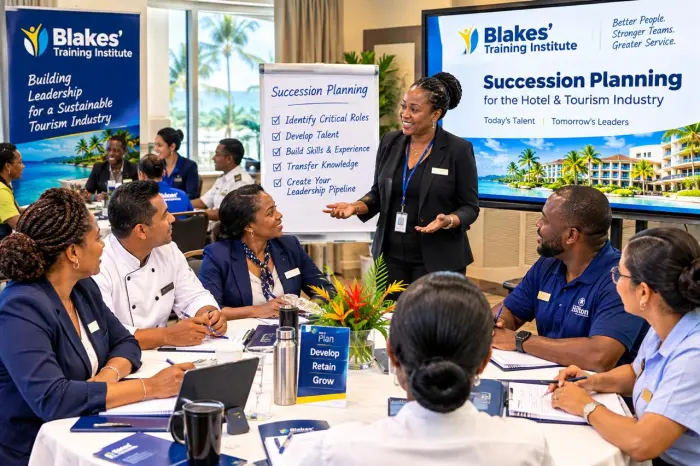
What this programme addresses
Hotels and tourism businesses depend heavily on experienced managers, supervisors and skilled frontline employees. When key people leave, retire, are promoted or become unavailable, organisations can experience disruption, loss of institutional knowledge and leadership gaps.
This workshop helps tourism organisations identify critical positions, develop internal talent, transfer knowledge and create a structured pipeline of employees who are prepared to take on greater responsibility. It positions succession planning as an ongoing talent-management process rather than simply identifying a replacement for a single senior role.
Participants will examine how succession planning can be applied across leadership, technical and operational positions that are important to guest service, revenue, safety and business continuity.
Workshop objectives
- Identify Critical Positions – Enable participants to identify leadership, technical and operational positions where vacancies could significantly affect guest service, revenue, safety or business continuity.
- Identify and Assess Potential Successors – Develop practical methods for identifying employees with the competencies, performance, potential and leadership behaviours required for future roles.
- Develop Individual Development Plans – Equip managers to create development plans involving coaching, mentoring, job rotation, cross-training, projects, acting assignments and targeted training.
- Strengthen Knowledge Transfer – Develop strategies for capturing and transferring institutional knowledge, operational procedures, customer knowledge and technical expertise before key employees leave their positions.
- Build a Hospitality Leadership Pipeline – Help organisations create a structured pathway from Frontline Employee -> Team Leader -> Supervisor -> Assistant Manager -> Manager -> Senior Leader, where appropriate.
- Establish a Sustainable Succession System – Enable HR and management teams to integrate succession planning into performance management, talent reviews, workforce planning and organisational strategy.
Recommended participants
- General Managers
- Hotel Managers
- Resort Managers
- Assistant General Managers
- Executive Directors
- Department Heads
- Operations Managers
- Front Office Managers and Supervisors
- Housekeeping Managers and Supervisors
- Food and Beverage Managers and Supervisors
- Restaurant Managers
- Guest Relations Managers
- Reservations Managers
- Sales and Marketing Managers
- Human Resource Managers
- Finance Managers
- Engineering and Maintenance Managers
- Security Managers
- Recreation and Entertainment Managers
- HR Managers and Officers
- Learning and Development Managers
- Training Managers
- Talent Management Officers
- Performance Management Officers
- High-potential employees
- High-performing supervisors
- Assistant managers
- Team leaders
- Employees preparing for management
- Employees with critical technical or operational knowledge
- Emerging hospitality leaders
Best suited for
Senior managers, departmental leaders, HR and talent-development personnel, supervisors and high-potential employees who have a role in identifying, preparing or developing future leaders and critical-role successors within hotels and tourism organisations.
How the learning can be applied
Succession planning should be used as an ongoing talent-management and business-continuity process covering critical positions throughout the organisation, not simply as a replacement plan for the General Manager. Hotels and tourism businesses should identify roles where the loss of the current employee would significantly affect guest service, revenue, safety, technical continuity or day-to-day operations, then build development pathways for potential successors. Examples include Front Office -> Front Office Supervisor -> Front Office Manager -> Rooms Division Manager, and F&B Team Leader -> F&B Supervisor -> Restaurant Manager -> F&B Manager.
Key topics
- Succession planning in the hospitality and tourism context
- Business continuity and the risk of critical-position vacancies
- Identifying critical leadership, technical and operational roles
- Assessing succession risk and organisational vulnerability
- Identifying high-potential and high-performing employees
- Assessing competencies, performance, potential and leadership behaviours
- Successor readiness and development gaps
- Creating individual development plans
- Coaching and mentoring for future roles
- Job rotation and cross-training
- Stretch projects and acting assignments
- Targeted training and leadership development
- Capturing institutional and operational knowledge
- Knowledge-transfer plans for key employees
- Building departmental and organisation-wide leadership pipelines
- Career pathways from frontline employee to senior leadership
- Linking succession planning with performance management
- Using talent reviews to monitor successor readiness
- Integrating succession planning with workforce planning and organisational strategy
- Developing a practical succession-planning action plan