
Succession Planning for Financial Institutions: Building Tomorrow's Leaders Today
A practical succession planning workshop that helps financial institutions identify critical roles, assess future leaders, develop internal talent, transfer institutional knowledge and strengthen leadership continuity.
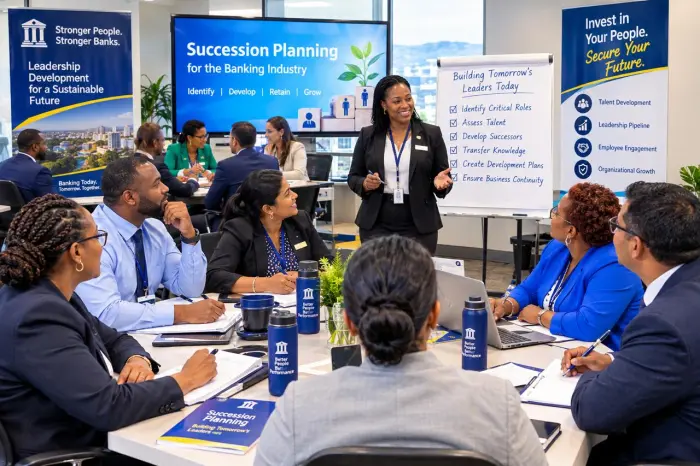
What this programme addresses
Succession planning is particularly important in banking and financial services because leadership changes, retirement, transfers, resignations and the loss of experienced employees can affect customer service, operational continuity, risk management, regulatory compliance and institutional knowledge. This workshop equips financial institutions to systematically identify critical roles, develop internal talent, transfer knowledge and build a sustainable leadership pipeline.
Workshop objectives
- Identify Critical Positions
- Enable participants to identify positions that are essential to business continuity, customer service, risk management, regulatory compliance and organisational performance.
- Identify and Assess Potential Successors
- Develop practical approaches for assessing employees based on performance, competencies, leadership potential, experience and readiness for future responsibilities.
- Build Individual Development Plans
- Equip managers to create structured development plans using coaching, mentoring, job rotation, cross-training, special projects, acting assignments and targeted education.
- Strengthen Knowledge Transfer
- Help institutions capture and transfer critical institutional, technical, customer and operational knowledge before experienced employees leave key positions.
- Develop a Leadership Pipeline
- Create deliberate pathways for employees to progress appropriately from Employee → Team Leader → Supervisor → Assistant Manager → Manager → Senior Leader.
- Establish a Sustainable Succession System
- Enable HR and management to integrate succession planning with performance management, talent reviews, workforce planning, career development and strategic planning.
Recommended participants
- Senior and Executive Leadership:
- Chief Executive Officers / Managing Directors
- Deputy / Assistant Managing Directors
- Senior Managers
- General Managers
- Department Heads
- Branch Managers
- Regional / Area Managers
- Banking and Operations Leadership:
- Assistant Branch Managers
- Operations Managers
- Operations Supervisors
- Customer Service Managers / Supervisors
- Credit Managers
- Lending Managers
- Treasury Managers
- Finance Managers
- Risk Managers
- Compliance Managers
- Internal Audit Managers
- IT / Digital Banking Managers
- Talent and People Development:
- HR Managers / Business Partners
- Learning & Development Managers
- Talent Management Officers
- Training Officers
- Performance Management Officers
- Potential Successors:
- High-performing employees
- High-potential employees
- Assistant managers
- Supervisors and team leaders
- Experienced officers with specialist knowledge
- Employees preparing for management
- Emerging leaders
- Employees identified through talent reviews
Best suited for
Financial institutions seeking to strengthen leadership continuity, reduce key-person risk, prepare high-potential employees for future roles and integrate succession planning with wider talent and workforce management.
How the learning can be applied
This workshop is best applied as an institutional talent-management intervention rather than a one-off replacement exercise. Financial institutions should begin by identifying roles where an unexpected vacancy could materially affect operations, customer service, risk management, regulatory compliance or organisational performance. From there, managers and HR teams can assess successor readiness, establish development plans, strengthen knowledge transfer and build structured leadership pipelines.
Examples of progression pathways include:
Customer Service Officer → Supervisor → Assistant Branch Manager → Branch Manager
Credit Officer → Credit Supervisor → Credit Manager → Senior Credit Manager
Operations Officer → Operations Supervisor → Operations Manager
Compliance Officer → Compliance Manager → Head of Compliance
The programme is particularly useful when aligned with annual talent reviews, workforce planning, performance management, career development and strategic planning.
Key topics
- Understanding succession planning in financial institutions
- Critical-role and key-person risk mapping
- Assessing role criticality
- Identifying high-potential and high-performing employees
- Performance versus potential
- Successor readiness assessment
- Competency and leadership-gap analysis
- Individual development planning
- Coaching and mentoring
- Job rotation and cross-training
- Acting assignments and stretch projects
- Career-path development
- Institutional and technical knowledge transfer
- Leadership pipeline design
- Talent review discussions
- Integrating succession with performance management
- Integrating succession with workforce planning
- Monitoring successor readiness
- Governance and accountability for succession planning