
Succession Planning for Churches & Faith-Based Organizations: Preparing Today's Servants for Tomorrow's Leadership
A practical succession-planning workshop that helps churches and faith-based organizations identify future leaders, develop emerging talent, preserve ministry knowledge and build a sustainable leadership pipeline.
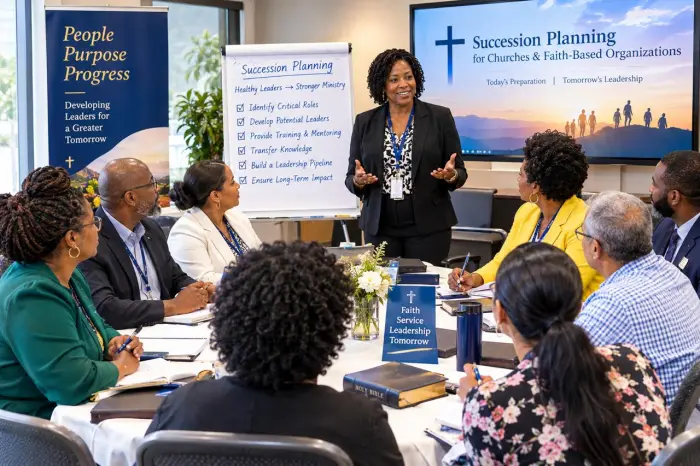
What this programme addresses
Churches and faith-based organizations depend on committed leaders, ministry workers, volunteers, institutional knowledge and trusted relationships. Effective succession planning helps ensure that when a pastor, ministry leader, administrator, board member or key volunteer moves on, the organization can continue its mission with minimal disruption. This workshop helps faith-based organizations identify future leaders, develop their capabilities, transfer knowledge and establish a healthy leadership pipeline while remaining faithful to their mission, values, doctrine and governance principles.
Workshop objectives
- Identify Critical Leadership and Ministry Roles
- Help organizations identify positions that are essential to the continuity of worship, ministry, administration, community service, governance and organizational operations.
- Identify and Develop Potential Successors
- Equip leaders with practical approaches for recognizing individuals with the character, commitment, competencies, spiritual maturity, leadership capacity and experience appropriate for future responsibilities.
- Create Individual Leadership Development Plans
- Help churches establish development plans involving mentoring, coaching, ministry assignments, leadership opportunities, training, job shadowing and cross-ministry exposure.
- Strengthen Knowledge and Ministry Continuity
- Develop ways to preserve and transfer important institutional knowledge, ministry practices, relationships, administrative processes and organizational history.
- Build a Sustainable Leadership Pipeline
- Help organizations intentionally develop leaders through a pathway such as Member → Ministry Volunteer → Ministry Leader → Department Leader → Senior Ministry / Administrative Leader, adapted to the organization's governance and ministry structure.
- Establish a Healthy Succession Culture
- Help leaders integrate succession planning into leadership development, mentoring, performance or service reviews, ministry planning and organizational governance rather than waiting until a leader suddenly leaves.
Recommended participants
- Senior and Spiritual Leadership:
- Pastors / Ministers
- Bishops / Presiding Leaders
- Assistant / Associate Pastors
- Ministry Directors
- Elders
- Deacons / Deacon Leaders
- Presiding Officers
- Regional / District Leaders
- Ministry and Department Leaders:
- Youth Ministry Leaders
- Children's Ministry Leaders
- Women's Ministry Leaders
- Men's Ministry Leaders
- Music / Worship Leaders
- Sunday School / Christian Education Leaders
- Outreach / Evangelism Leaders
- Missions Leaders
- Small-Group / Life-Group Leaders
- Community-Service Leaders
- Administrative and Governance Leadership:
- Church Administrators
- Executive / Administrative Pastors
- Church Board Members
- Trustees
- Finance Committee Leaders
- Human Resource / People Leaders
- Operations / Facilities Leaders
- Communications / Media Leaders
- Programme / Project Leaders
- Potential Successors:
- Assistant Ministry Leaders
- Emerging Leaders
- Young Adult Leaders
- High-Performing Volunteers
- Ministry Coordinators
- Sunday School Teachers
- Small-Group Leaders
- Experienced Members Demonstrating Leadership Potential
- Staff Members Preparing for Greater Responsibility
- Individuals Being Mentored for Future Leadership
Best suited for
Churches, denominations, ministries, para-church organizations, Christian institutions and other faith-based organizations seeking to strengthen leadership continuity, develop emerging leaders, preserve institutional knowledge and reduce disruption when key leaders transition.
How the learning can be applied
This workshop is best applied as an ongoing leadership-development and ministry-continuity process rather than as an emergency response when a leader is preparing to leave. Organizations should begin by identifying critical spiritual, ministry, administrative and governance roles, then assess potential successors, establish development pathways and create structured mechanisms for mentoring and knowledge transfer.
Examples of leadership pathways may include:
Youth Leader → Assistant Youth Leader → Youth Ministry Director
Ministry Volunteer → Small-Group Leader → Ministry Coordinator → Ministry Director
Administrative Officer → Administrator → Senior Administrator
Each organization should adapt succession pathways to its own doctrine, governance structure, ministry model and leadership practices.
Key topics
- Understanding succession planning in churches and faith-based organizations
- Leadership and ministry continuity risk
- Identifying critical spiritual, ministry, administrative and governance roles
- Recognizing emerging leaders
- Character, commitment and spiritual maturity in leadership assessment
- Competency and readiness assessment
- Leadership-development planning
- Mentoring and coaching
- Ministry assignments and stretch opportunities
- Job shadowing and cross-ministry exposure
- Developing young and emerging leaders
- Volunteer leadership development
- Institutional knowledge transfer
- Documenting ministry processes and organizational history
- Leadership pipeline design
- Governance continuity
- Transition planning for pastors and ministry leaders
- Board and administrative succession
- Integrating succession planning with ministry planning
- Creating a healthy culture of leadership development
- Monitoring successor readiness and development progress