
Corporate Governance for Financial Institutions
Three-day professional development workshop for directors, senior executives and oversight professionals in financial institutions.
What this programme addresses
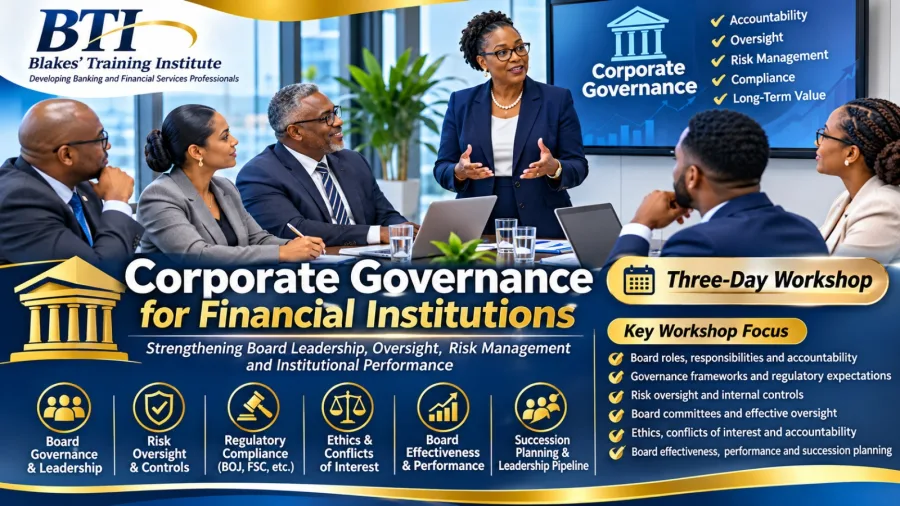
Effective corporate governance is fundamental to the stability, integrity, accountability and long-term sustainability of financial institutions. As the financial services sector faces increasing regulatory expectations, technological developments, emerging risks and growing stakeholder demands, boards of directors and senior management must demonstrate strong leadership, sound judgement and effective oversight.
This three-day workshop is designed to strengthen the governance competencies of directors, senior executives, board committee members and other professionals responsible for institutional oversight. Participants will examine the principles and practices of effective corporate governance, including board responsibilities, regulatory compliance, risk management, internal controls, ethical leadership, board performance and succession planning.
Special attention will be given to the governance requirements and regulatory environment affecting financial institutions in Jamaica, including the roles of the Bank of Jamaica (BOJ), the Financial Services Commission (FSC) and other relevant authorities, where applicable.
Through practical case studies, boardroom simulations, governance assessments, group discussions and performance measurement exercises, participants will develop the knowledge and tools necessary to strengthen governance structures, improve decision-making, manage institutional risks and promote sustainable organisational performance.
Workshop objectives
- Apply effective corporate governance principles and regulatory requirements. Explain the fundamental principles of corporate governance, board accountability, fiduciary responsibilities and regulatory expectations applicable to financial institutions.
- Strengthen board leadership, committee effectiveness and institutional accountability. Evaluate the roles and responsibilities of boards, directors, board committees and senior management, including delegation of authority, oversight arrangements and effective decision-making.
- Enhance risk governance and internal control oversight. Apply risk governance principles to evaluate institutional risk appetite, internal controls, compliance arrangements, audit findings and the effectiveness of risk management systems.
- Promote ethical leadership, transparency and responsible decision-making. Identify and manage conflicts of interest, uphold professional integrity, strengthen accountability and promote an ethical organisational culture.
- Evaluate board effectiveness and institutional governance performance. Apply governance assessment tools, performance indicators, board evaluations and succession planning techniques to identify weaknesses and strengthen governance practices.
- Develop and implement practical governance improvement strategies. Prepare governance action plans that address identified gaps, strengthen board and management oversight, improve regulatory compliance and support institutional sustainability.
Recommended participants
- Chairpersons and members of boards of directors.
- Members of audit, risk, credit, governance and compliance committees.
- Chief executive officers, managing directors and general managers.
- Senior executives and departmental managers.
- Corporate secretaries and governance officers.
- Chief risk officers and risk management professionals.
- Compliance officers and regulatory affairs personnel.
- Internal auditors and heads of internal audit.
- Human resource executives responsible for leadership development and succession planning.
- Emerging leaders preparing for executive or board-level responsibilities.
Best suited for
The workshop is particularly suitable for individuals responsible for strategic direction, governance, oversight, risk management and institutional accountability.
Target institutions: Commercial banks, credit unions, building societies, microfinance institutions, insurance companies, investment firms and other financial services organisations.
Key topics
- Day 1 — Corporate Governance Foundations, Board Leadership and Accountability
- Corporate governance principles and frameworks; fiduciary responsibilities; board composition, independence and competence; responsibilities of directors and senior management; board committee structures; delegation and accountability; ethical leadership; conflicts of interest; regulatory governance expectations; board effectiveness and decision-making.
- Practical exercise: Governance gap analysis using a fictional Jamaican financial institution.
- Day 2 — Risk Governance, Internal Controls and Institutional Performance
- Enterprise risk management; board-approved risk appetite; the Three Lines Model; internal controls; audit and compliance oversight; regulatory risk; financial reporting integrity; operational resilience; cybersecurity and digital governance; board performance indicators; leadership succession planning and talent development.
- Practical exercise: Risk appetite escalation memorandum and governance KPI dashboard.
- Day 3 — Governance Effectiveness, Strategic Oversight and Continuous Improvement
- Board evaluation methods; governance reporting; strategic decision-making; stakeholder accountability; management performance monitoring; corrective action tracking; governance improvement frameworks; effective board meetings; governance crisis response; boardroom simulations and implementation planning.