
IFRS 9 for Financial Institutions
A three-day workshop for financial officers in Jamaica’s banking industry on IFRS 9 classification and measurement, expected credit losses, governance and financial reporting.
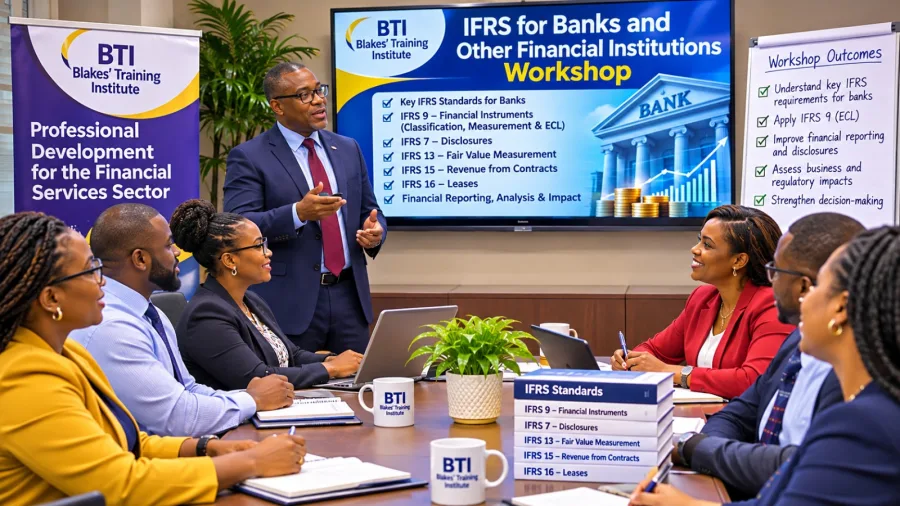
What this programme addresses
Theme — Strengthening Financial Reporting, Credit Risk Assessment, Expected Credit Loss Management & Regulatory Readiness
IFRS 9 – Financial Instruments is one of the most important accounting standards affecting banks and other financial institutions because it influences how financial assets and liabilities are classified, measured, impaired and reported. Of particular importance to lending institutions is the Expected Credit Loss (ECL) model, which requires institutions to recognise credit losses using forward-looking information rather than waiting until a loss has already occurred. Effective IFRS 9 implementation therefore requires close coordination among finance, credit, risk management, collections, treasury, information technology, compliance, senior management and internal audit.
This three-day workshop gives financial professionals a practical understanding of IFRS 9 and its application in the Jamaican banking environment. Participants will examine classification and measurement, the business-model assessment, the SPPI test, amortised cost, FVOCI, FVTPL, the three-stage ECL model, Significant Increase in Credit Risk (SICR), Probability of Default (PD), Loss Given Default (LGD), Exposure at Default (EAD), forward-looking economic scenarios, loan modifications, write-offs, governance, disclosures and model controls. The programme will also connect IFRS 9 with related standards, including IFRS 7, IFRS 13, IAS 32, and other relevant financial-reporting requirements, while examining the relationship between accounting impairment, credit-risk management, and prudential supervision.
Workshop objectives
- Explain the core requirements of IFRS 9. Understand the purpose, scope and structure of IFRS 9, including classification and measurement, impairment and hedge accounting, and explain their significance to financial institutions.
- Classify and measure financial instruments appropriately. Apply the business-model assessment and contractual cash-flow/SPPI principles to determine whether relevant financial assets are measured at amortised cost, FVOCI or FVTPL, while understanding the treatment of financial liabilities.
- Apply the IFRS 9 Expected Credit Loss model. Understand and apply 12-month and lifetime ECL, including Stage 1, Stage 2 and Stage 3 concepts and the movement of exposures between stages.
- Understand the major components of ECL measurement. Explain and apply the concepts of PD, LGD and EAD, discounting, expected cash shortfalls, forward-looking information and probability-weighted economic scenarios.
- Strengthen IFRS 9 governance, controls and reporting. Understand the responsibilities of finance, credit, risk, management, committees, data/IT, compliance and internal audit in maintaining reliable IFRS 9 processes, assumptions, models and financial reporting.
- Connect IFRS 9 with related IFRS and regulatory requirements. Understand how IFRS 9 interacts with IFRS 7, IFRS 13, IAS 32 and other relevant accounting standards, as well as applicable BOJ prudential and regulatory requirements.
Recommended participants
- Chief Financial Officers
- Finance managers and financial controllers
- Financial accountants
- Financial and regulatory reporting officers
- Credit managers
- Credit officers and credit analysts
- Loan officers and lending managers
- Credit-risk managers and analysts
- Enterprise-risk professionals
- Collections and recovery managers
- Portfolio managers
- Treasury and ALCO personnel
- Internal auditors
- External-audit liaison personnel
- Compliance officers
- Data analysts and MIS personnel supporting IFRS 9
- IT personnel responsible for ECL systems and data
- Model-risk and model-validation professionals
- Senior managers responsible for finance, risk or lending
- Audit and Risk Committee members requiring an executive understanding of IFRS 9
Best suited for
The programme can be adapted for commercial banks, building societies, credit institutions, microfinance organisations and other financial institutions according to their applicable accounting and regulatory requirements.
Key topics
- Day 1 — IFRS 9 Classification and Measurement
- Scope, business-model assessment and contractual cash flows (SPPI)
- Amortised cost, FVOCI and FVTPL
- Financial liabilities and an introduction to hedge accounting
- Day 2 — Expected Credit Loss Measurement
- Stage 1, Stage 2 and Stage 3, SICR and movements between stages
- 12-month and lifetime ECL, PD, LGD, EAD, discounting and cash shortfalls
- Forward-looking information and probability-weighted scenarios
- Loan modifications and write-offs
- Day 3 — Governance, Controls and Financial Reporting
- Governance roles, data quality, model controls and validation
- Financial reporting and disclosure links to IFRS 7, IFRS 13 and IAS 32
- Accounting impairment, credit-risk management and applicable BOJ prudential requirements